<h1 data-pm-slice="1 1 []">Overlooked Tax Planning Strategies for Growing Businesses: R&D Credits, Cost Segregation, and Entity Optimization</h1>
<p>Tax season can bring an unpleasant surprise for business owners. A company may experience strong revenue growth, hire new employees, invest in technology, and expand its operations, only to discover that its tax liability is much higher than anticipated. By the time the annual return is prepared, many opportunities to improve the outcome may already have passed.</p>
<p>Several tax planning strategies can help growing businesses manage these challenges more effectively. Research and development (R&D) tax credits, cost segregation studies, appropriate business entity selection, and carefully calculated estimated tax payments can all play an important role. However, these strategies generally deliver the greatest value when incorporated into financial planning throughout the year.</p>
<p>This article provides general educational information, not individualized tax advice. Business owners should consult qualified tax professionals to determine which strategies apply to their specific circumstances.</p>
<h2>Why Growing Businesses Often Miss Valuable Tax Benefits</h2>
<p>Many businesses approach taxes as an annual administrative responsibility. Their accounting teams finalize the books, prepare financial statements, file the necessary returns, and move on to other priorities. <a href="https://k38consulting.com/startup-cfo">startup tax planning</a></p>
<p>While this process may be sufficient for a relatively stable business, it becomes less effective as an organization expands. Growing companies frequently hire technical employees, develop new products, acquire property, raise investment capital, and enter additional states. Each decision can have tax implications.</p>
<p>One major challenge is the disconnect between business operations and tax planning. Founders and managers make decisions throughout the year, while external tax advisors may receive the necessary information only during filing season.</p>
<p>Effective startup tax planning brings these two activities together. By reviewing hiring decisions, research expenditures, property investments, and ownership structures throughout the year, companies can identify potential tax benefits before important deadlines pass.</p>
<h2>Can Your Business Benefit From the R&D Tax Credit?</h2>
<p>The federal research and development tax credit under Section 41 of the Internal Revenue Code encourages eligible businesses to invest in qualifying research activities. Eligible expenses may include wages for employees performing qualified research, certain supplies used during experimentation, and eligible contract research expenses.</p>
<p>The credit is not limited to pharmaceutical laboratories or scientific research facilities. Software companies, manufacturers, engineering firms, and businesses developing innovative products may also qualify.</p>
<p>To determine eligibility, businesses generally need to demonstrate that their activities satisfy four requirements:</p>
<ol start="1" data-spread="false">
<li>
<p><strong>Permitted purpose:</strong> The work aims to develop or improve a product, process, software application, technique, or formula in a qualifying way.</p>
</li>
<li>
<p><strong>Technological foundation:</strong> The activity relies on engineering, computer science, or other qualifying scientific principles.</p>
</li>
<li>
<p><strong>Technical uncertainty:</strong> The company faces uncertainty about the capability, appropriate design, or method needed to achieve the intended result.</p>
</li>
<li>
<p><strong>Experimentation:</strong> The team evaluates alternatives through testing, modeling, prototyping, or other systematic processes.</p>
</li>
</ol>
<p>Routine maintenance, ordinary cosmetic changes, and work that does not meet the applicable requirements may not qualify. Businesses should evaluate individual projects rather than assume that all development expenses are eligible.</p>
<h3>Using the R&D Credit to Reduce Payroll Taxes</h3>
<p>Early-stage companies often spend substantial amounts on product development before generating taxable profits. Although an R&D credit may be available, a business with little or no income tax liability may not be able to use the entire benefit immediately against income taxes.</p>
<p>Certain qualified small businesses can elect to apply a portion of their research credit against eligible employer payroll taxes, subject to statutory requirements and annual limits. Generally, the election is available to qualifying businesses with gross receipts below $5 million and no gross receipts before the five-tax-year period ending with the current tax year.</p>
<p>This provision can help eligible pre-revenue software startups and life sciences companies obtain a more immediate financial benefit from qualifying research activities.</p>
<p>Accurate records are essential. Businesses should maintain project descriptions, employee time records, expense classifications, technical documentation, and evidence of experimentation. Companies receiving biotech accounting and CFO support can establish appropriate project-level tracking systems early, making it easier to substantiate eligible costs.</p>
<h3>Understanding Section 174 Research Expense Rules</h3>
<p>Section 174 addresses the tax treatment of research and experimental expenditures, which is distinct from the R&D tax credit.</p>
<p>The treatment of these expenses has changed in recent years. Earlier rules required capitalization and amortization of specified research costs, while subsequent legislation restored immediate expensing for qualifying domestic research expenditures and introduced additional considerations for certain foreign research costs and prior tax years.</p>
<p>Because these provisions can affect taxable income, cash flow, and tax elections, companies should review the current rules with a qualified advisor before preparing their returns or changing their accounting procedures.</p>
<h2>How Cost Segregation Can Improve Real Estate Tax Planning</h2>
<p>Cost segregation is a tax planning method that uses engineering and accounting analysis to identify building components that may qualify for shorter depreciation periods.</p>
<p>Under general federal rules, nonresidential real property is typically depreciated over 39 years, while residential rental property is generally depreciated over 27.5 years. However, certain qualifying components may fall into shorter depreciation categories, including five-, seven-, or 15-year property.</p>
<p>Depending on the building and its use, these components may include specialized equipment-related electrical systems, certain finishes, carpeting, parking areas, and landscaping.</p>
<p>By identifying eligible assets, a cost segregation study can accelerate depreciation deductions into earlier years. Where qualifying property is eligible for bonus depreciation, the potential timing benefit may be even greater under the applicable law.</p>
<p>The strategy does not necessarily increase the total depreciation available over the property's lifetime. Instead, it can shift deductions toward earlier years, potentially freeing up cash for business expansion, debt reduction, or additional investments.</p>
<h3>Which Businesses Should Consider Cost Segregation?</h3>
<p>Cost segregation is not exclusively for large commercial property investors. Several types of businesses may benefit from evaluating a study:</p>
<ul data-spread="false">
<li>
<p>Companies purchasing or constructing their own office headquarters.</p>
</li>
<li>
<p>Healthcare providers owning medical office buildings.</p>
</li>
<li>
<p>Manufacturers investing in production facilities.</p>
</li>
<li>
<p>Commercial property owners completing substantial renovations.</p>
</li>
<li>
<p>Real estate investors undertaking qualifying tenant improvements.</p>
</li>
</ul>
<p>The financial case depends on the property's depreciable basis, eligible components, study cost, expected ownership period, available taxable income, and potential depreciation recapture when the property is sold.</p>
<p>Businesses working with real estate accounting and CFO professionals can compare the expected tax benefit with the cost of the study and the long-term implications before proceeding.</p>
<h2>Choosing the Right Business Entity as Your Company Grows</h2>
<p>A business entity determines how an organization is structured for legal and tax purposes. Common options include limited liability companies (LLCs), S corporations, and C corporations.</p>
<p>Many founders choose an entity when launching their business and never revisit the decision. Yet the best structure for a small owner-operated company may not be appropriate after the business begins hiring employees, attracting investors, or preparing for an eventual sale.</p>
<p>Each structure has different tax consequences, ownership restrictions, administrative requirements, and financing implications.</p>
<h3>LLCs, S Corporations, and C Corporations Compared</h3>
<p><strong>LLC taxed as a partnership:</strong> This structure generally provides flexibility in allocating profits and managing ownership interests. It is often considered by partnerships, professional businesses, and real estate investors. Federal tax treatment depends on the LLC's classification and elections.</p>
<p><strong>S corporation:</strong> Eligible businesses may elect pass-through taxation, subject to shareholder, ownership, and other requirements. Owner-employees must receive reasonable compensation for services performed. The structure may be worth evaluating for certain profitable owner-operated businesses.</p>
<p><strong>C corporation:</strong> A C corporation generally pays corporate income tax, and shareholders may also owe tax on dividends. Despite this potential double taxation, the structure is often preferred by venture-backed startups seeking institutional investment, issuing certain employee equity awards, or planning for a qualifying stock sale.</p>
<h3>Qualified Small Business Stock and Growth Planning</h3>
<p>The qualified small business stock (QSBS) exclusion under Section 1202 may allow eligible shareholders to exclude some or all of the gain from selling qualifying stock, subject to applicable requirements and limitations.</p>
<p>Eligibility depends on several factors, including the corporation's structure, the nature of its business, asset-related requirements, the date and circumstances of stock issuance, and the applicable holding period. Recent legislative changes have also affected certain thresholds and rules for eligible stock.</p>
<p>Founders should not assume that forming a C corporation automatically makes their shares eligible for QSBS treatment. Early advice from tax and legal professionals can help establish whether the company and its shareholders satisfy the relevant requirements.</p>
<p>Owner-operated service businesses may need to focus on different considerations, including reasonable compensation, state tax obligations, and pass-through entity tax elections. Real estate investors may also use separate LLCs for liability management, financing, and ownership purposes.</p>
<p>Ultimately, entity planning should reflect the company's current operations, anticipated financing needs, ownership arrangements, and long-term exit strategy.</p>
<h2>Managing Estimated Taxes Through Year-Round Planning</h2>
<p>Unexpected tax bills can create serious cash flow problems for growing companies and their owners. Estimated tax payments help taxpayers meet their obligations throughout the year rather than paying everything when returns are filed.</p>
<p>Corporations and individuals with pass-through business income may have estimated payment obligations, depending on their circumstances. These payments generally follow a four-installment schedule, although the specific rules differ by taxpayer type.</p>
<p>Rapid growth makes accurate estimates particularly important. A business that earned modest profits last year may generate substantially more taxable income this year. Relying entirely on previous results can therefore leave the company underprepared.</p>
<p>Federal safe harbor rules may help taxpayers avoid underpayment penalties when payments satisfy the applicable requirements. However, following a safe harbor does not necessarily mean that the taxpayer will have no remaining balance due when filing.</p>
<p>A regularly updated tax projection can help management estimate taxable income, adjust payments when appropriate, and reserve enough cash to cover upcoming obligations.</p>
<h3>A Practical Quarterly Tax Planning Schedule</h3>
<p><strong>First quarter: Review the previous year.</strong> Finalize financial records, evaluate potential R&D credits, review depreciation opportunities, and confirm relevant elections and filing requirements.</p>
<p><strong>Second quarter: Update financial projections.</strong> Compare actual results with the budget, estimate annual taxable income, and reassess upcoming estimated tax payments.</p>
<p><strong>Third quarter: Review structural changes.</strong> Evaluate entity arrangements, potential state tax obligations arising from employees or business activities in new locations, and planned property or equipment purchases.</p>
<p><strong>Fourth quarter: Prepare for year-end.</strong> Review eligible expenditures, compensation plans, capital investment decisions, and other transactions that may affect the company's tax position.</p>
<p>A consistent schedule helps businesses make informed decisions before deadlines arrive. It also improves communication between business owners, accounting teams, and external tax advisors.</p>
<h2>How Fractional CFO Support Can Strengthen Tax Planning</h2>
<p>Tax planning becomes more effective when it is integrated with broader financial management. Companies need reliable forecasts, organized expense records, accurate cash flow projections, and a clear understanding of how operational decisions affect profitability.</p>
<p>A fractional CFO can help management coordinate these activities, prepare financial forecasts, assess major investments, and communicate with tax professionals. Although a fractional CFO may support tax strategy, specialized tax advice and tax return preparation should be handled by appropriately qualified professionals.</p>
<p>K-38 Consulting, a Raleigh, North Carolina-based firm led by founder Dallas Alford IV, CPA, provides fractional CFO services that include support for financial planning and tax-related strategies such as R&D tax credit evaluation and cost segregation planning for businesses nationwide.</p>
<p>The value of this support lies in connecting financial information with business decisions. Rather than waiting until filing season, management can review potential tax implications while budgets, hiring plans, research projects, and capital investments are still being developed.</p>
<h2>Build a Better Tax Strategy Before the Next Filing Season</h2>
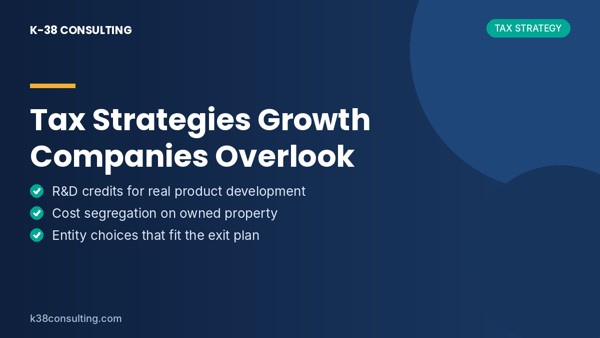
<p>R&D credits, cost segregation, entity optimization, and estimated tax planning are established components of business tax management. Their usefulness depends on eligibility, accurate documentation, appropriate timing, and compliance with current tax law.</p>
<p>The most effective approach is to make tax planning a regular part of financial decision-making instead of treating it as a once-a-year obligation.</p>
<p>Start by reviewing three areas: ongoing research and development projects, owned or improved real estate, and the company's current legal and tax structure. Discuss these findings with a qualified tax advisor and establish a quarterly review process.</p>
<p>Taking action earlier can provide more opportunities to evaluate available options, manage cash flow, and make informed decisions as the company grows.</p>
<h2>Frequently Asked Questions About Business Tax Planning</h2>
<h3>1. Can a software startup qualify for the R&D tax credit?</h3>
<p>Yes. A software startup may qualify when its development activities satisfy the applicable federal requirements for qualified research. The work generally needs a permitted purpose, a technological basis, technical uncertainty, and a process of experimentation. Routine maintenance and cosmetic changes may not qualify. Project documentation, development tickets, design records, and employee time tracking can help support a claim.</p>
<h3>2. What is the R&D payroll tax credit election?</h3>
<p>The election allows eligible small businesses to apply a portion of their federal research credit against qualifying employer payroll taxes instead of income tax, subject to applicable limits. Eligibility generally includes a gross receipts threshold below $5 million and restrictions involving gross receipts in earlier tax years. Businesses should confirm their eligibility and filing requirements with a tax professional.</p>
<h3>3. Is cost segregation worthwhile for a small commercial property?</h3>
<p>It can be, depending on the property's depreciable basis, qualifying components, study cost, available deductions, and expected holding period. A preliminary financial analysis can help determine whether the potential tax benefit justifies the expense. The owner should also consider the property's future sale and any resulting depreciation recapture.</p>
<h3>4. Should a growing LLC convert to a C corporation?</h3>
<p>A conversion may be appropriate for a business planning to raise institutional venture capital, introduce certain equity compensation arrangements, or pursue an exit that may qualify for QSBS benefits. However, a C corporation can introduce corporate-level taxation and additional compliance requirements. The decision should account for financing plans, ownership, state taxes, and potential future transactions.</p>
<h3>5. How can a business avoid estimated tax penalties?</h3>
<p>Businesses and their owners should determine which estimated tax rules apply to them and calculate payments using the relevant safe harbor or current-year tax projection methods. Reviewing forecasts quarterly and setting aside funds regularly can help reduce underpayment risk and prevent unexpected cash flow pressure.</p>
<h3>6. What records should a company maintain for an R&D tax credit claim?</h3>
<p>Useful records may include project descriptions, technical objectives, development timelines, employee time records, payroll data, qualifying supply expenses, contractor agreements, testing results, and documentation of technical uncertainty and experimentation. Records should be maintained as the work occurs rather than reconstructed entirely at year-end.</p>
<h3>7. Does cost segregation increase total depreciation deductions?</h3>
<p>Cost segregation generally changes the timing and classification of depreciation deductions rather than automatically increasing the total amount depreciable. Identifying qualifying components may accelerate deductions into earlier years, but the results depend on applicable tax rules, property characteristics, and the owner's circumstances.</p>
<h3>8. How often should a growing company review its tax strategy?</h3>
<p>A quarterly review is a practical starting point, with additional reviews when major events occur. Examples include significant hiring, fundraising, acquiring real estate, expanding into new states, launching research projects, or preparing for a business sale. Regular reviews help management identify opportunities and obligations before important deadlines.</p>
<h3>9. Can a fractional CFO provide tax planning support?</h3>
<p>A fractional CFO can help integrate tax considerations into budgeting, cash flow forecasting, investment decisions, and financial reporting. They can also coordinate with the company's CPA or tax advisor. The scope of tax advice depends on the professional's qualifications, engagement, and applicable regulations.</p>
<h3>10. When should a company begin year-end tax planning?</h3>
<p>Ideally, tax planning should begin at the start of the financial year and continue throughout each quarter. Early planning gives a company more time to organize documentation, evaluate investment decisions, review entity arrangements, and consult qualified professionals before filing deadlines.</p>