# The Behavioral Economics of Mining Tokens: Why Time-Investment Creates Stronger Hands Than Capital-Investment
[](https://postimg.cc/vDBzxc5k)
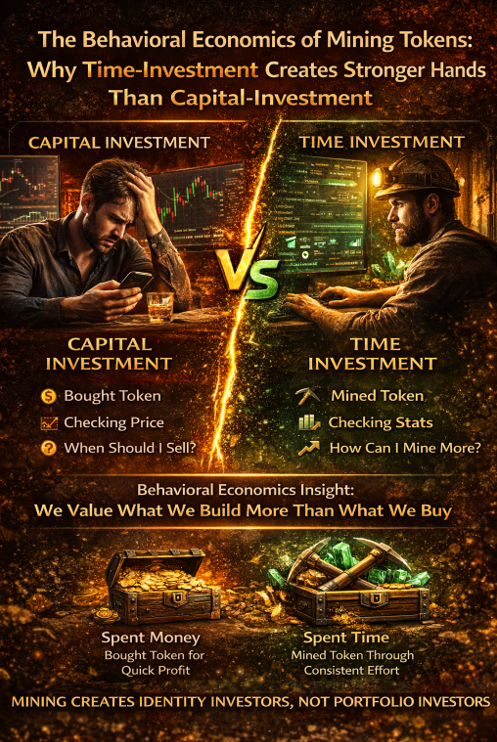
<p>Every crypto trader knows the feeling: you buy a token, it pumps 30%, and you immediately start thinking about exit points. You're monitoring the chart. You're setting stop-losses. You're calculating whether to take profit or let it ride.</p>
<p>Now compare that to a completely different experience: you've spent three weeks mining a token. You've logged in daily. You've optimized your strategy. You've watched your balance grow from zero through consistent participation.</p>
<p>When that token pumps 30%, you don't think about selling. You think about mining more.</p>
<p><strong>This psychological difference is why mining-based store-of-value tokens create fundamentally different market structures than traditional buy-first tokens—and it's why this category keeps expanding across chains in 2026.</strong></p>
<p>Solana established the category with projects like ORE.supply and GODL. Base experimented with auction-driven participation through Pizza City. Now BNB Chain has the scale to prove whether this behavioral model works at true retail magnitude with <span style="text-decoration: underline;"><strong><a href="https://binarium.supply">Binarium as its native mining primitive</a>.</strong></span></p>
<h2><strong>The Endowment Effect: Why We Value What We Build</strong></h2>
<p>Behavioral economics has a name for this phenomenon: <strong>the endowment effect</strong>.</p>
<p>People assign higher value to things they own simply because they own them. But the effect intensifies when ownership comes through effort rather than purchase.</p>
<p>Traditional research shows this clearly:</p>
<ul>
<li>People who build IKEA furniture value it more highly than identical pre-assembled furniture</li>
<li>Lottery participants who choose their own numbers are less willing to trade tickets than those given random numbers</li>
<li>Employees who earn stock through vesting hold longer than those who buy shares outright</li>
</ul>
<p>The pattern is consistent: <strong>effort of acquisition increases perceived value</strong>.</p>
<p>Mining tokens weaponize this insight at scale.</p>
<p>When you mine a store-of-value token, you're not just acquiring an asset. You're investing time, attention, and strategic thinking. Each unit of supply becomes connected to a memory of earning it. That creates an emotional premium traditional purchases never generate.</p>
<h2><strong>The Sunk Cost Fallacy Works in Holders' Favor</strong></h2>
<p>Critics of behavioral economics often point to the "sunk cost fallacy" as irrational behavior—continuing something because you've already invested in it, even when stopping would be optimal.</p>
<p>But in crypto markets, this "fallacy" creates exactly the market structure long-term holders want: <strong>sticky supply that doesn't panic-sell at the first correction</strong>.</p>
<p>Consider two scenarios:</p>
<p><strong>Scenario A: Traditional Token Purchase</strong></p>
<ul>
<li>User buys $1,000 worth at launch</li>
<li>Token drops 30% in week one</li>
<li>User's mental calculation: "I'm down $300, should I cut losses?"</li>
<li>Behavioral pressure: Minimize regret by exiting</li>
</ul>
<p><strong>Scenario B: Mining Token Accumulation</strong></p>
<ul>
<li>User mines daily for three weeks, accumulating equivalent value</li>
<li>Token drops 30% in week four</li>
<li>User's mental calculation: "I earned this through effort, the price drop doesn't change what I built"</li>
<li>Behavioral pressure: Continue the ritual, don't "waste" the time already invested</li>
</ul>
<p>The second scenario creates holders who double down during dips instead of capitulating. Not because they're financially smarter—but because the psychological relationship to the asset is different.</p>
<h2><strong>Mining Creates "Identity Investors" Not "Portfolio Investors"</strong></h2>
<p>Here's where mining-based distribution fundamentally changes community dynamics.</p>
<p>When you buy a token, you're a <strong>portfolio investor</strong>. Your relationship to the asset is transactional. You allocated capital, you expect return, and when the thesis breaks you rotate out.</p>
<p>When you mine a token daily, you become an <strong>identity investor</strong>. The asset isn't just in your portfolio—it's part of your routine, your strategy, your social proof within the community.</p>
<p>Identity investors behave differently in every measurable way:</p>
<p><strong>Portfolio Investors:</strong></p>
<ul>
<li>Check price frequently</li>
<li>Sell pressure increases with volatility</li>
<li>Community participation is passive (lurking, not contributing)</li>
<li>Exit when "better opportunities" appear</li>
</ul>
<p><strong>Identity Investors:</strong></p>
<ul>
<li>Check mining stats frequently (price is secondary)</li>
<li>Volatility triggers "buy the dip" or "mine more" behavior</li>
<li>Community participation is active (teaching, strategizing, defending)</li>
<li>Exit requires breaking a habit, not just changing allocation</li>
</ul>
<p>This is exactly what happened with early Bitcoin miners, with Helium network participants, and now with Solana's mining-first store-of-value tokens. The mechanism creates a tribe, not just a holder base.</p>
<h2><strong>Time as Proof-of-Belief</strong></h2>
<p>Traditional crypto investing sends a simple signal: "I allocated capital to this opportunity."</p>
<p>Mining sends a different signal: "I believe in this enough to invest my time repeatedly."</p>
<p>Time is the ultimate scarce resource. You can always find more capital, borrow leverage, or reallocate from other positions. But you can't create more hours in the day.</p>
<p>When someone demonstrates sustained time investment in mining a token, they're signaling something much stronger than a whale accumulating a position in one transaction:</p>
<p><strong>They're revealing their belief through behavior, not just words.</strong></p>
<p>This is why mining communities develop such strong social cohesion. Every participant can see who's actually committed through on-chain activity. There's no way to fake consistent daily mining. It's transparent proof-of-belief.</p>
<p>And in crypto, where trust is scarce and scams are common, <strong>transparent proof-of-belief becomes the foundation for legitimate community formation</strong>.</p>
<h2><strong>The "Daily Active Holder" Metric That Traditional Tokens Can't Replicate</strong></h2>
<p>Most tokens measure success through:</p>
<ul>
<li>Price performance</li>
<li>Trading volume</li>
<li>Total holders</li>
<li>Market cap</li>
</ul>
<p>Mining tokens unlock a new metric that's actually more predictive of long-term survival: <strong>Daily Active Miners (DAM)</strong>.</p>
<p>This metric answers the question traditional holder counts can't: "How many people are still showing up when there's no immediate price catalyst?"</p>
<p>A token with 10,000 holders but 50 daily active miners is speculative froth.<br /> A token with 5,000 holders and 2,000 daily active miners is building culture.</p>
<p>The second project will likely outlive the first because participation creates stickiness that passive holding never generates.</p>
<p>This is the structural advantage BNB Chain could exploit with a properly designed mining primitive. BNB already has one of crypto's highest daily active user counts. If a store-of-value mining token can convert even 5% of that activity into daily miners, the scale would exceed anything Solana or Base has produced.</p>
<h2><strong>How Mining Behavior Changes Market Cycles</strong></h2>
<p>Traditional tokens follow predictable cycle patterns:</p>
<ol>
<li>Launch hype → early buyers accumulate</li>
<li>Price discovery → profit-taking begins</li>
<li>Correction → weak hands exit</li>
<li>Slow bleed → only believers remain</li>
<li>Next catalyst → cycle repeats or dies</li>
</ol>
<p>Mining tokens introduce a different cycle:</p>
<ol>
<li>Launch phase → early miners experiment</li>
<li>Habit formation → miners optimize strategies</li>
<li>Community growth → social proof attracts new miners</li>
<li>Mining becomes culture → price becomes secondary metric</li>
<li>External attention arrives → new cycle begins with existing engaged base intact</li>
</ol>
<p>Notice the key difference: <strong>traditional tokens lose participants during corrections, while mining tokens can actually grow participation during boring markets</strong> because the reward for mining doesn't depend solely on price appreciation.</p>
<p>This behavioral pattern is exactly why ORE.supply maintained community engagement through Solana's volatile periods in 2024-2025. Mining created its own reward loop independent of chart performance.</p>
<h2><strong>The BNB Chain Behavioral Advantage</strong></h2>
<p>BNB Chain has a specific user behavior profile that's uniquely suited for mining-based distribution:</p>
<p><strong>High Frequency:</strong> Users already transact daily, not weekly<br /> <strong>Incentive-Driven:</strong> The ecosystem trains users to chase rewards actively<br /> <strong>Retention-Focused:</strong> Binance's broader platform creates "sticky" users who don't chain-hop constantly</p>
<p>These aren't theoretical advantages. They're observable patterns in how BNB users already behave across DeFi protocols, launchpads, and trading platforms.</p>
<p>The question was never "can BNB users adopt mining behavior?" It was "which project would build the mining primitive that matches how they already think?"</p>
<p>That's the positioning Binarium is targeting: not importing Solana's culture, but building the <strong><span style="text-decoration: underline;"><a href="https://binarium.supply">BNB-native store-of-value mining experience</a></span> </strong>that leverages existing behavioral infrastructure.</p>
<h2><strong>The Long-Term Implication: Communities Over Capitalization</strong></h2>
<p>By 2026, the smartest crypto projects have learned a hard lesson:</p>
<p><strong>Market cap is rented. Community is owned.</strong></p>
<p>You can pump market cap through listings, partnerships, and hype cycles. But the moment attention moves, the cap evaporates unless there's a community that believes independent of price.</p>
<p>Mining-based distribution builds that community as a structural output, not a marketing goal.</p>
<p>Every day someone mines creates:</p>
<ul>
<li>A micro-commitment to the ecosystem</li>
<li>A social proof point for new participants</li>
<li>A behavioral pattern that resists external disruption</li>
<li>A story to tell other community members</li>
</ul>
<p>Multiply that across thousands of daily miners over months, and you get something rare in crypto: <strong>genuine network effects that aren't just financial speculation</strong>.</p>
<h2><strong>The Competitive Future: Distribution Becomes the Moat</strong></h2>
<p>In the next wave of crypto, distribution won't be something projects do before they "get serious." Distribution will be the moat itself.</p>
<p>The projects that survive won't be the ones with the best tech stacks or the most VC funding. They'll be the ones that created behavioral loops so strong that users can't leave even when they want to.</p>
<p>Solana's mining tokens proved the model works.<br /> Base's experiments showed it can take different forms.<br /> BNB Chain's scale could prove it can become a category-defining primitive.</p>
<p>The race now is which chain builds the most compelling behavioral loop for store-of-value mining—because the chain that wins that race doesn't just get a popular token.</p>
<p>It gets a community that shows up every day, regardless of what the chart does.</p>
<p>That's the real innovation: <strong>turning blockchain distribution into behavioral science</strong>, where every mining action becomes a vote of confidence that compounds over time.</p>
<p>And in 2026, that's the store-of-value narrative traders are starting to understand actually matters.</p>